‘Wild Bill’ Belvin: A Year in the Southwest Florida Wild
In 1930, William Tyre “Wild Bill” Belvin (1876–1963) walked into the undeveloped country along Charlotte Harbor and stayed for a year. He carried no conventional survival gear, living without clothes or weapons, just glasses and false teeth.
He hunted, fished and foraged in the mangrove and scrub country near Pine Island and present-day Cape Coral, Florida.
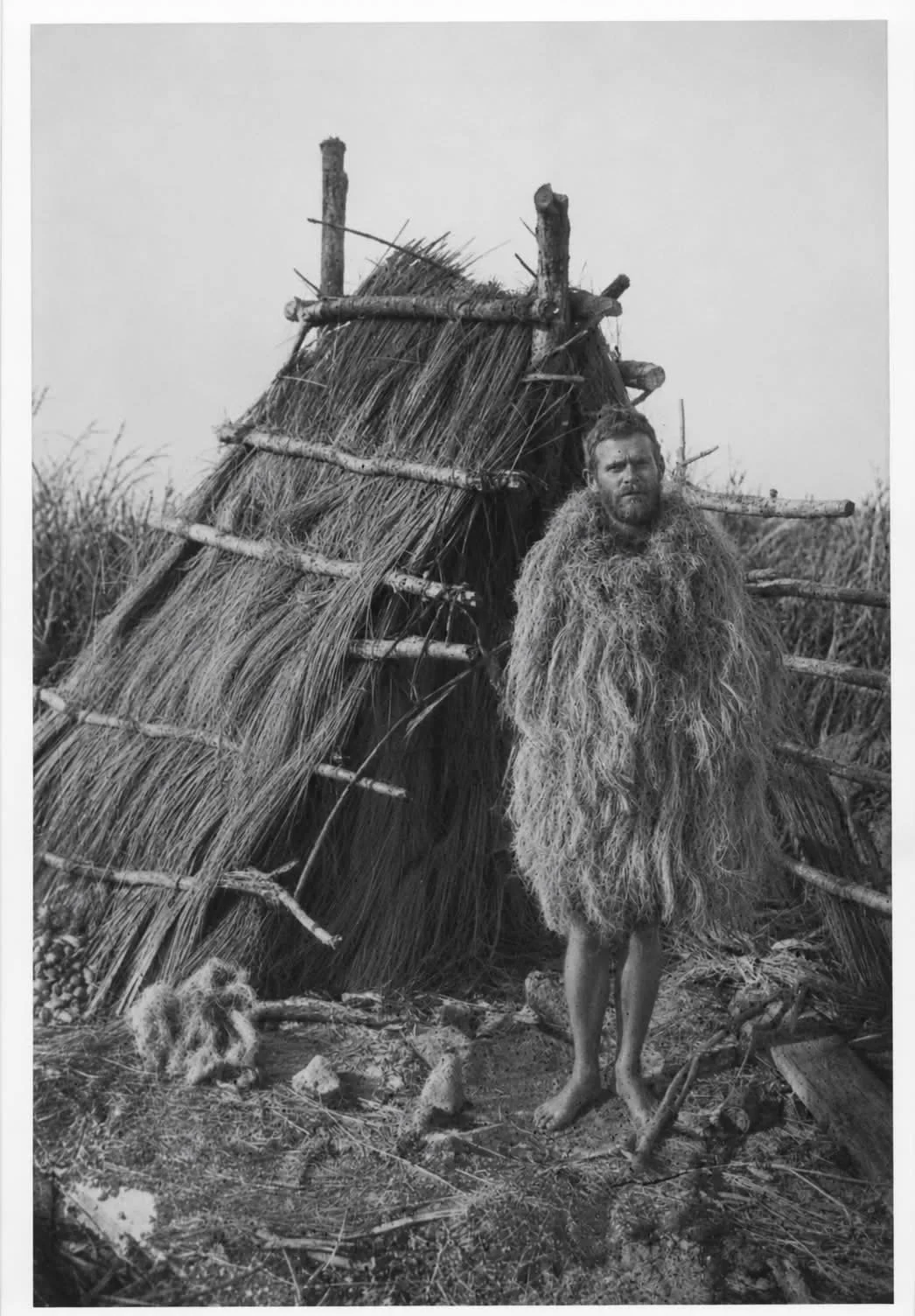
‘Wild Bill’ Belvin in 1930 standing in a ghillie suit in front of an A-frame style chickee hut during his survivalist year. Photograph courtesy of the Molter Family archive and restored with AI.
Belvin’s year in the woods attracted local press coverage and newspaper reporting throughout Georgia and other parts of the American Southeast.
He survived largely on fish, oysters, native plants and whatever else he could obtain from his surroundings.
Locally he was regarded as a strange, weird—but actually pretty impressive—local character who became one of the unofficial community fathers of Cape Coral that nurtured its development and shaped its culture, as well as raising its children.
Before we get into the legend of “Wild Bill” Belvin, it’s worth asking what might compel a man to go out into the wilderness for a year to start anew?
Early Marriage to Janie Elizabeth Hussey Belvin (1876 - 1919)
Before his wilderness stunt, William T. Belvin married Janie Elizabeth Hussey Belvin.
My great aunt Georgia Molter MacLean gives Janie an unusually vivid biography in her memoir Pine Island Road Girl.
She describes Janie as a traveling nurse in South Carolina who rode horseback to patients, many of them living in logging camps.
MacLean also writes that Janie became one of the first people in her area to own an automobile—an extraordinary degree of independence and mobility for a woman working in rural medicine in the early twentieth century.
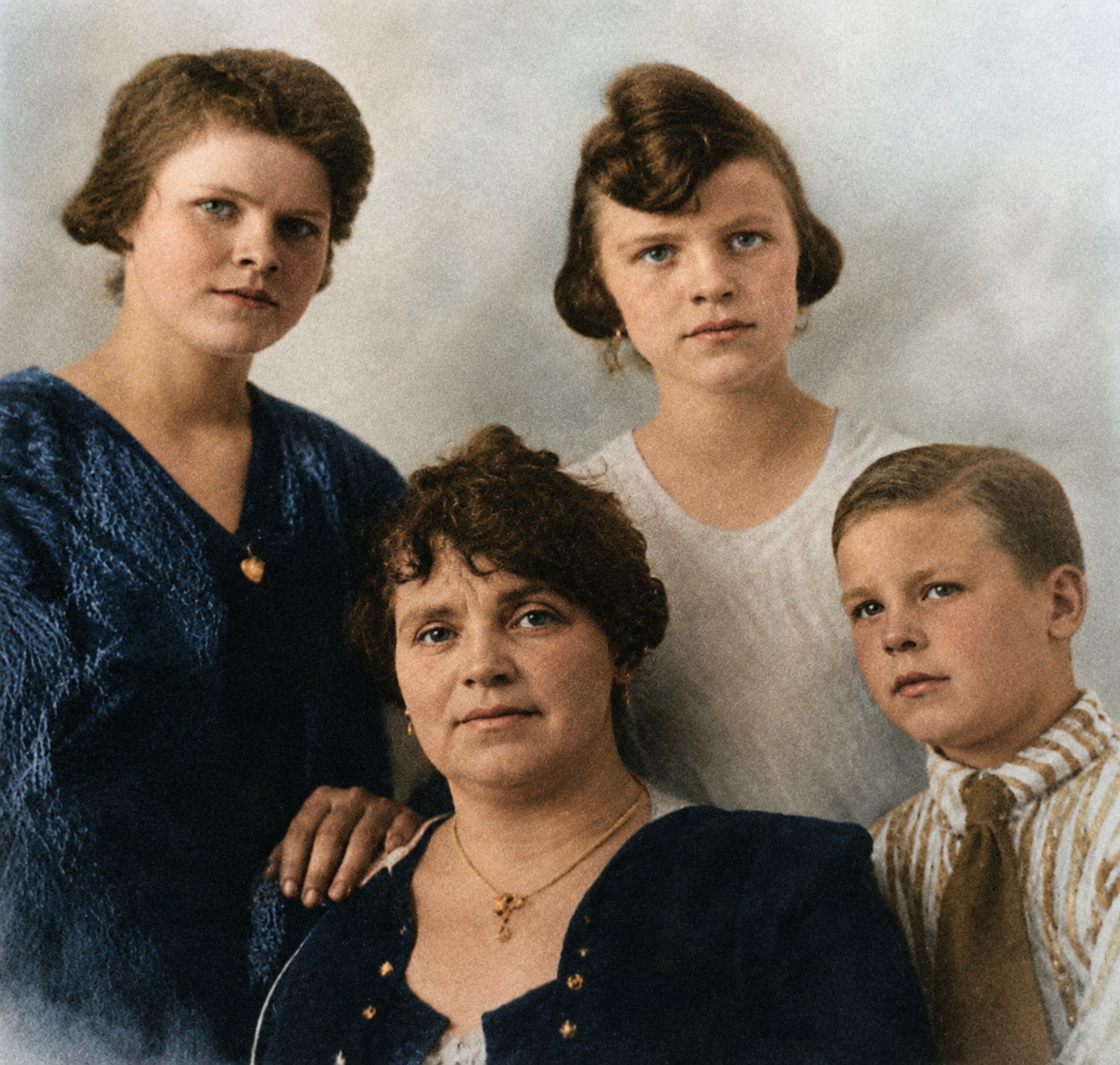
Image of Janie Hussey Belvin and her children. Photo reproduced in Georgia Molter MacLean, Pine Island Road Girl, p. 33. Colorized using AI.
But her marriage to Bill was troubled.
According to MacLean, Bill was then a Methodist circuit-riding preacher who abused Janie and subsequently lost his position with the church. The couple divorced and their children scattered among relatives.
Their daughter Beatrice remained in nursing school; Mae Eloise and Beaman lived for a time with relatives in Sumter and Savannah; and the family later separated further after Janie’s death.
In 1919, while working as a nurse, Janie drove off the side of a mountain and was decapitated in the automobile accident.
Janie and Bill had eight children, although four died in infancy: Beatrice Abigail (1902–1984), Mae Eloise (1903–1972), Beaman Pickett (1909–1955), Sara Elizabeth (born 1914), James, Lila, and unnamed twins.
Mae Eloise later married Urban Joseph Molter (1899–1981), bringing the Belvin family into the Molter line.
A Year in Exile
Belvin entered the Southwest Florida woods in 1930 to test whether a person could live for a year without the ordinary tools and supplies of modern life. He knew the region before beginning the experiment.
He demonstrated that he could obtain food and shelter from the Southwest Florida environment without conventional equipment.
Belvin undertook the experiment voluntarily. The Florida Writers’ Project described his purpose in 1940 as an attempt to prove that a person could still “live in primitive fashion.”
He conducted the experiment in Lee County near Charlotte Harbor, near the Burnt Store area, in present-day Cape Coral.
Return to Civilization
His return to Fort Myers produced an ending worthy of the nickname "Wild Bill.”
Belvin walked back into town after twelve months and sat down for his first haircut and shave.
The clearest source is a syndicated newspaper photograph and story published in November 1931. It shows Belvin immediately after emerging from the woods, described as “grass-skirted and unshaven.”
The accompanying report says Lee County Sheriff F. B. Tippens arrested Belvin on a charge of stealing pelican eggs from a protected rookery and eating pelicans.
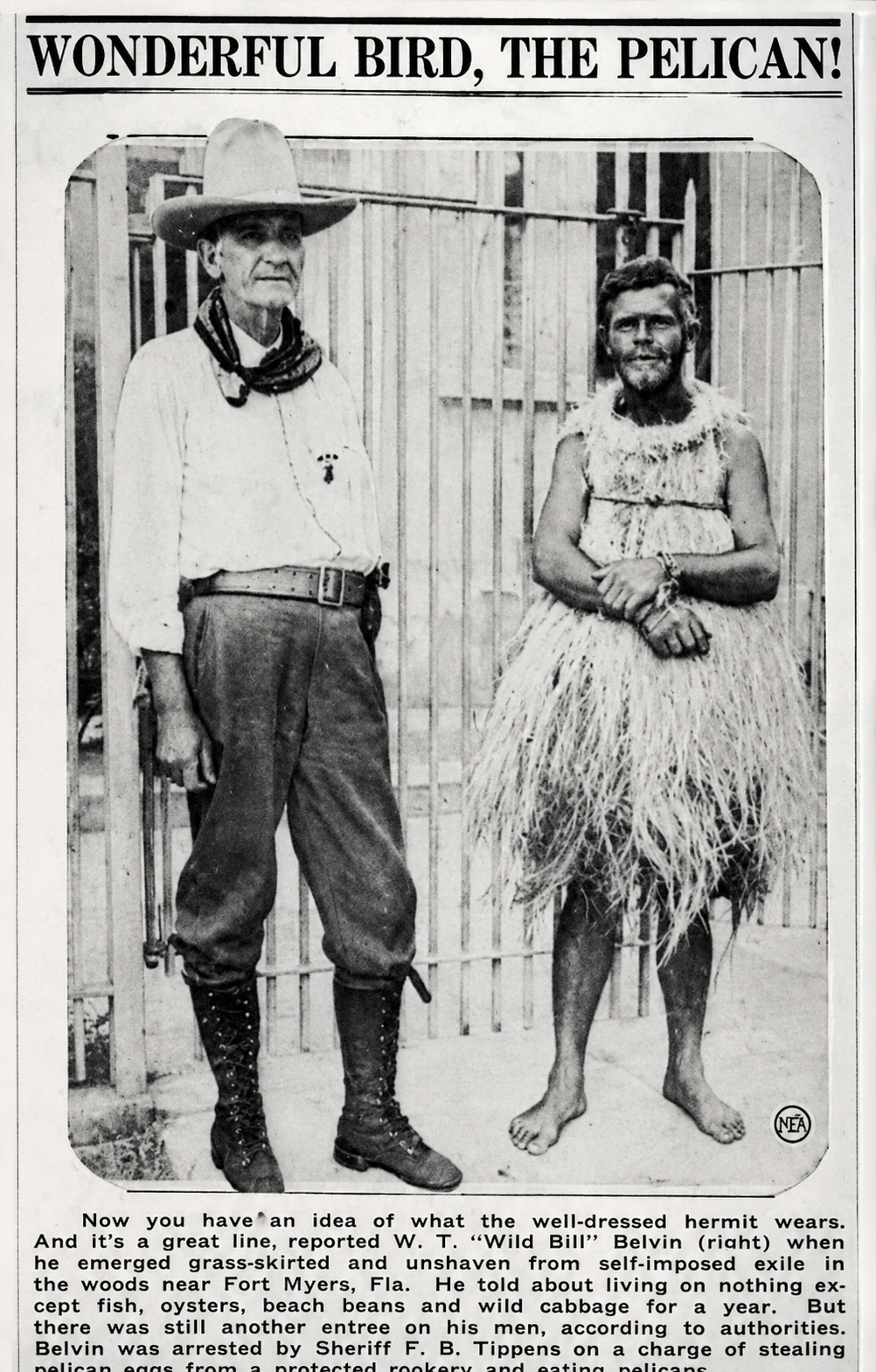
Image of Lee County Sheriff Frank B. Tippens standing beside William T. “Wild Bill” Belvin. Contemporary newspapers reported the charge, while a later Lee County Sheriff’s Office history described the arrest as “a gag” staged around the local celebrity’s return. I have found no evidence that Belvin received a conviction or fine.
Wildlife laws already limited what someone could legally take, even in comparatively remote Southwest Florida.
Before the barber could finish the transformation, a deputy arrested him.
A crowd had just welcomed him home, and Fort Myers had planned a banquet in his honor. The arrest postponed it. But there were no actual charges filed.
The arrest was reportedly another publicity stunt.
The sequence could hardly have been staged better: Wild Bill emerges from the wilderness. The town cheers. He sits down for a shave. The deputy arrives. Wild Bill goes to jail. His celebratory banquet gets postponed until his release.
The newspapers took the bait.
It was an early Florida publicity stunt with a perfect final act—and one more reason William Tyre “Wild Bill” Belvin earned his nickname.
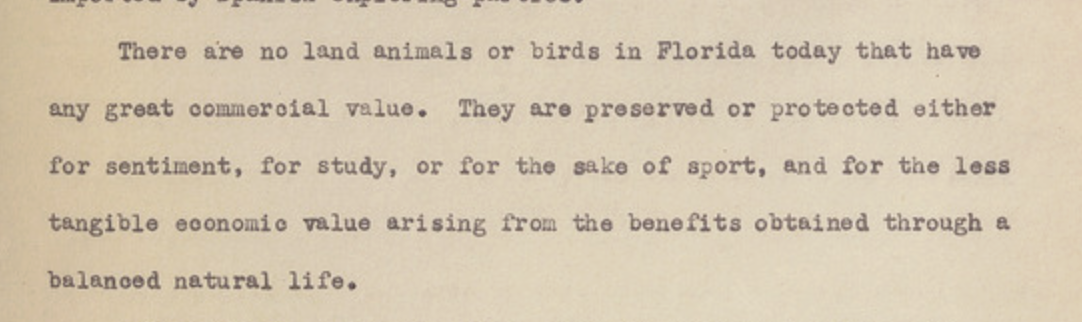
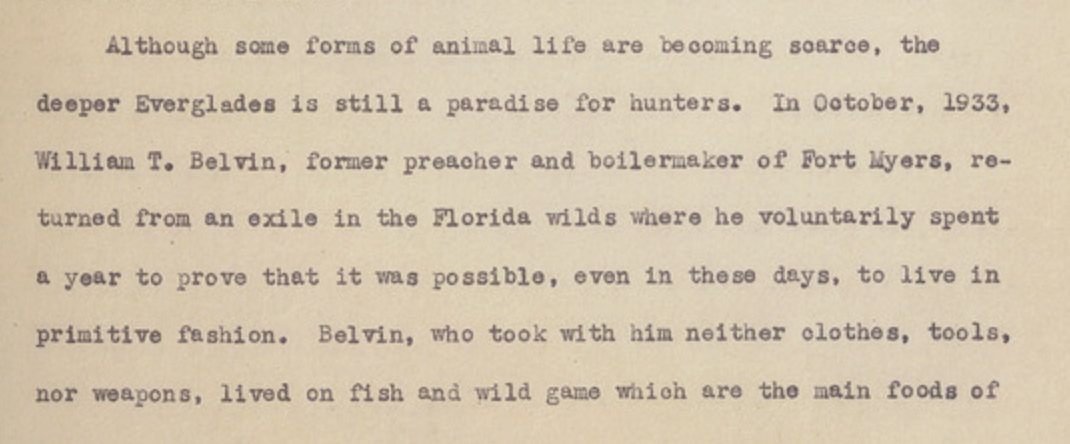

Image from the Florida Writers’ Project, 1940 — Guide to Greater Miami and Dade County. The guide misdates Belvin’s return (1931, not 1933) and wrongly relocates his episode to the “deeper Everglades”; it actually occurred northwest in the Pine Island–Charlotte Harbor area near today’s Cape Coral. The guide’s claims that wildlife had little commercial value and that Seminole foodways were simple are incorrect: Florida still supported a significant alligator‑hide trade, and Seminole hunting, fishing, farming, and culinary traditions were far more complex.
Homestead Life in Cape Coral
After the wilderness episode that made him famous as “Wild Bill” Belvin, he kept experimenting with ways to live and work from Southwest Florida’s natural resources.
In 1932, while working with Punta Gorda Fish Company fishermen around Crow Key and Bull Key, Belvin devised a process for cooking and drying predatory fish and fish scraps into fish meal and fertilizer. He presented samples to the Fort Myers Chamber of Commerce but there’s no evidence that the idea developed into a commercial operation.
Changing Cape Coral
Bill lived on his 160-acre Fort Myers-area homestead patented from the federal government in 1929.
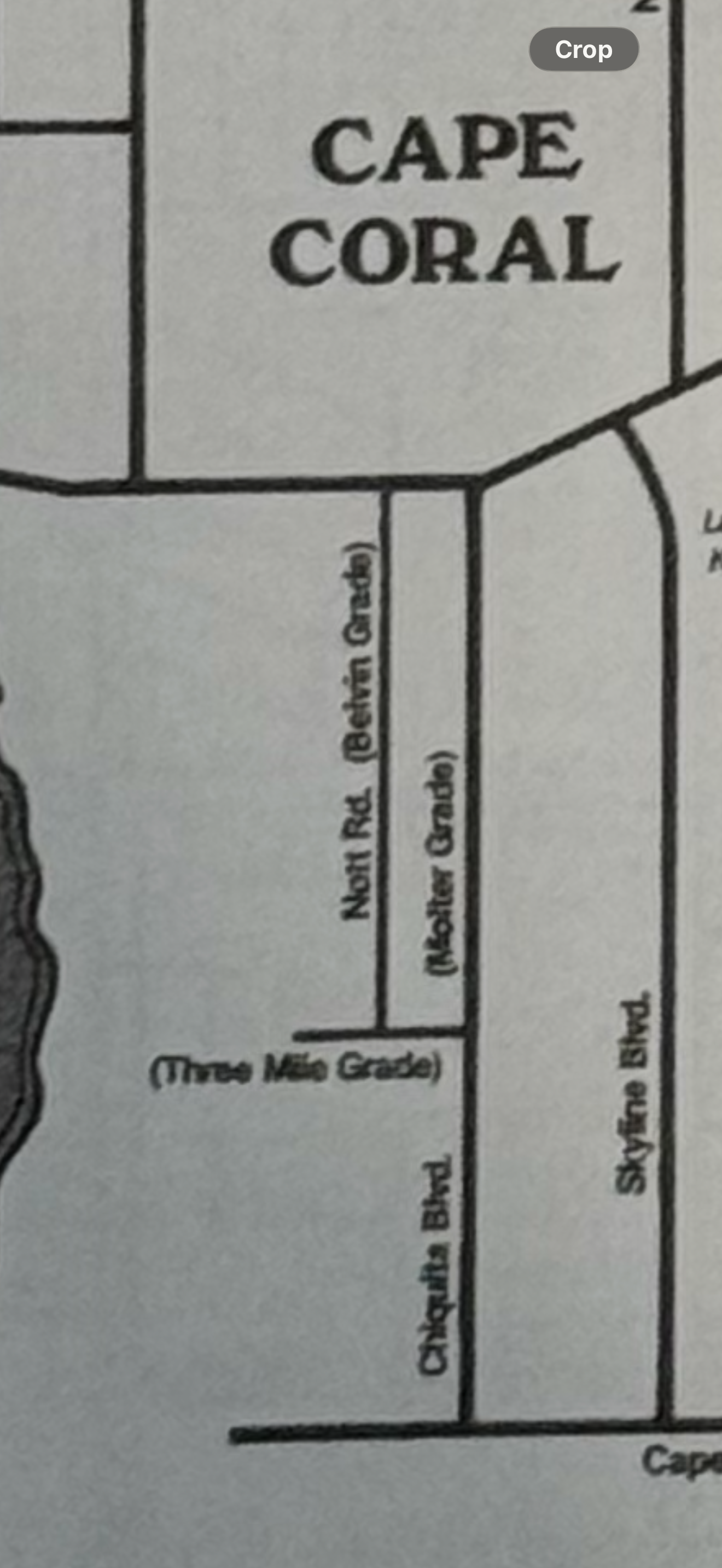
Image shows Nott Rd. (formerly Belvin Grade Rd.) and Molter Grade Rd. (now Chiquita Blvd.)
Belvin’s daughter Georgia described his first home there as a rough cabin resembling a Seminole chickee, with a thatched roof, log sides and sleeping platforms that folded against the walls.
He later built a two-room, tin-roofed house on stilts.
He eventually gave his land to the Methodists. The arrangement allowed him to live in a small house on Methodist property until his death.
Portions of the original property eventually became Trafalgar Middle School and the site of Blessed Katharine Drexel Catholic Church.
God has a great sense of humor
One of my favorite family stories to learn growing up was about the petty rivalry between the Molter and Belvin clans. My great aunt Georgia Molter MacLean explained what happened to the homesteads.
After giving the Methodists his land for a church, they did not need a church so far out in the country. They sold the property and used the money to expand a church in North Fort Myers.
Then came the part Wild Bill might not have appreciated: the Catholic Church acquired part of his old homestead.
Being a tough backwoods Methodist, he reportedly did not get along with his neighbors, the German Catholic Molter clan (also kin of mine).
Georgia remembered her Uncle Beaman warning the family not to tell Wild Bill that the Catholics had bought part of his land.
The property later became associated with a Catholic parish. Georgia clearly enjoyed the irony.
Her other grandfather’s property met an equally fitting fate. Jacob Molter’s land became a cemetery.
Georgia summed up the coincidence with one of the best lines in Pine Island Road Girl: she thought it fitting that God made a cemetery out of Grandpa Molter’s land and put a Catholic church on Grandpa Belvin’s land.
To Georgia, there was only one explanation: God had a great sense of humor.
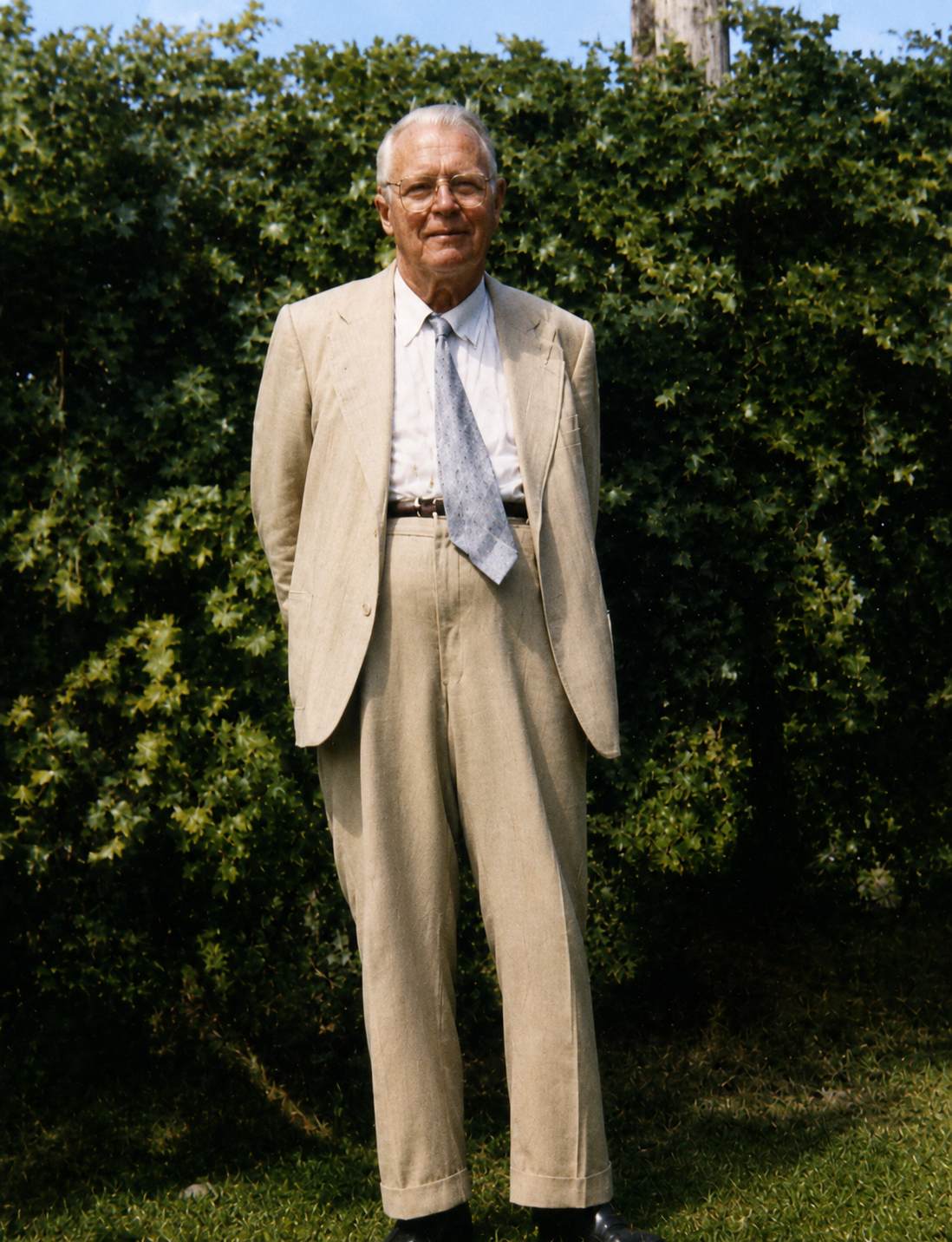
Image of William Tyre Belvin at his homestead in Fort Myers, Florida prior to sale. Courtesy of Georgia Molter MacLean Family Archive. Image colorized using AI.
A Modern Tribute
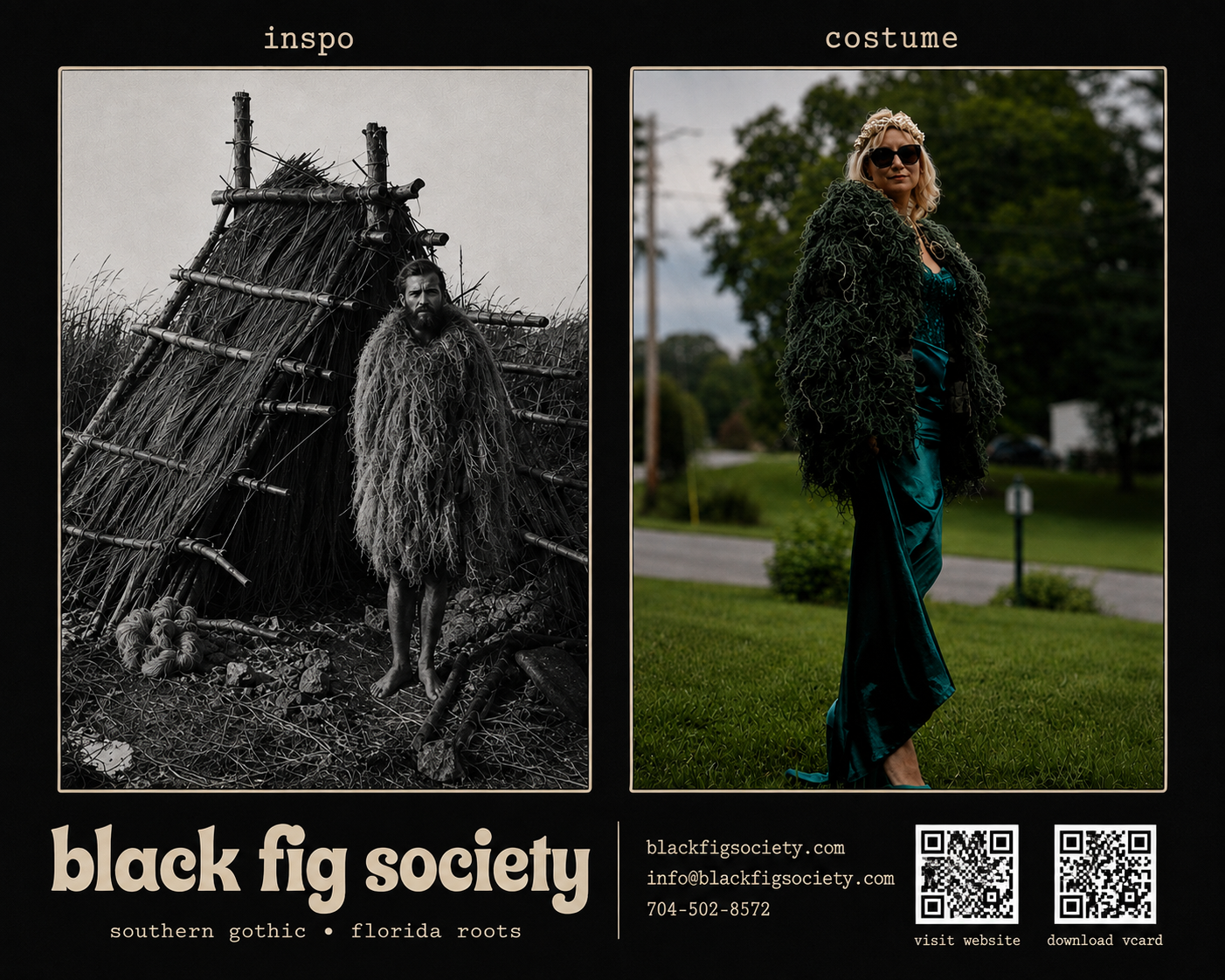
‘Wild Bill' Belvin in his ghillie suit in Pine Island in 1930 and my inspired “Miss Florida” costume, August 2026.
Nearly 100 years later, I turned Wild Bill Belvin’s wilderness experiment into costuming for public appearances to promote real Florida histories and storytelling.
I built the look around a dark green ghillie-style coat, its dense hanging fibers recalling the scrub, grasses and tangled vegetation of the Southwest Florida landscape where Belvin spent his year in voluntary exile.
Rather than reproduce Belvin literally, I paired that deliberately wild silhouette with an upcycled emerald evening gown, rhinestone trim, vintage-style sunglasses and a handmade Florida shell crown assembled from shells, starfish and pearls.
The result turns the wilderness survivalist into a Florida beauty queen: part swamp, part pageant, part family history.
‘Miss Florida sash’
The final piece is a handmade “Miss Florida” sash, constructed from burlap and gold trim.
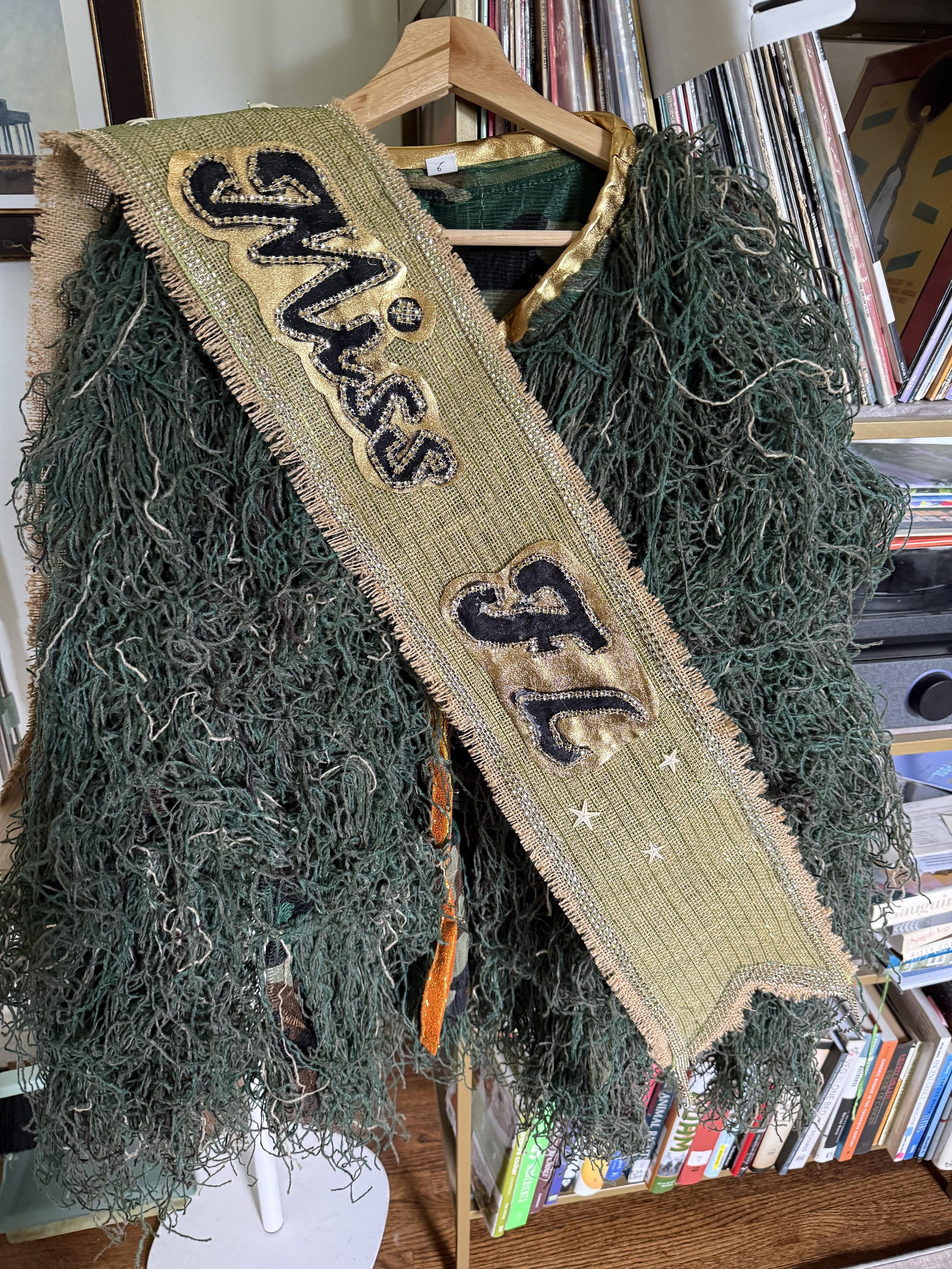
Image of ghillie suiting and “Miss Florida” satirical sash.
The contrast is intentional. Belvin became a local celebrity by presenting himself as a man who could conquer the Florida wilderness through ingenuity.
My costume avoids recreating a 1930s “pioneer” but contains some playful and cheeky symbolism.
The ghillie coat represents the adventurous and pioneering spirit of early South Florida people and later white settlers.
The reference is also personal. Wild Bill belongs to the extended Belvin-Molter-Smith family history connected to my grandmother.
So we are kin. And kindred spirits.
Sources and Attribution
Georgia Molter MacLean, Pine Island Road Girl, pp. 30–35, including the Belvin family history, family chart and reproduction of William T. Belvin’s 1929 federal homestead patent.
Prudy Taylor Board, Remembering Fort Myers: The City of Palms, including “The Saga of Wild Bill Belvin, 1930.” (Biggerbooks.com)
Punta Gorda History Center, research on Belvin’s 1932 fish-meal and fertilizer experiments on Charlotte Harbor. (Punta Gorda History Center Blog)
WGCU Public Media, “Wild Bill Belvin,” February 3, 2017. (WGCU News)
Florida Weekly, historical discussion of Belvin’s year living in the Gulf Coast wilderness. (UF Digital Collections)
Recommended Read: A Heap ‘O Livin’ (preorder)
If you enjoyed this story, more are available for preorder. Check out the link below <3
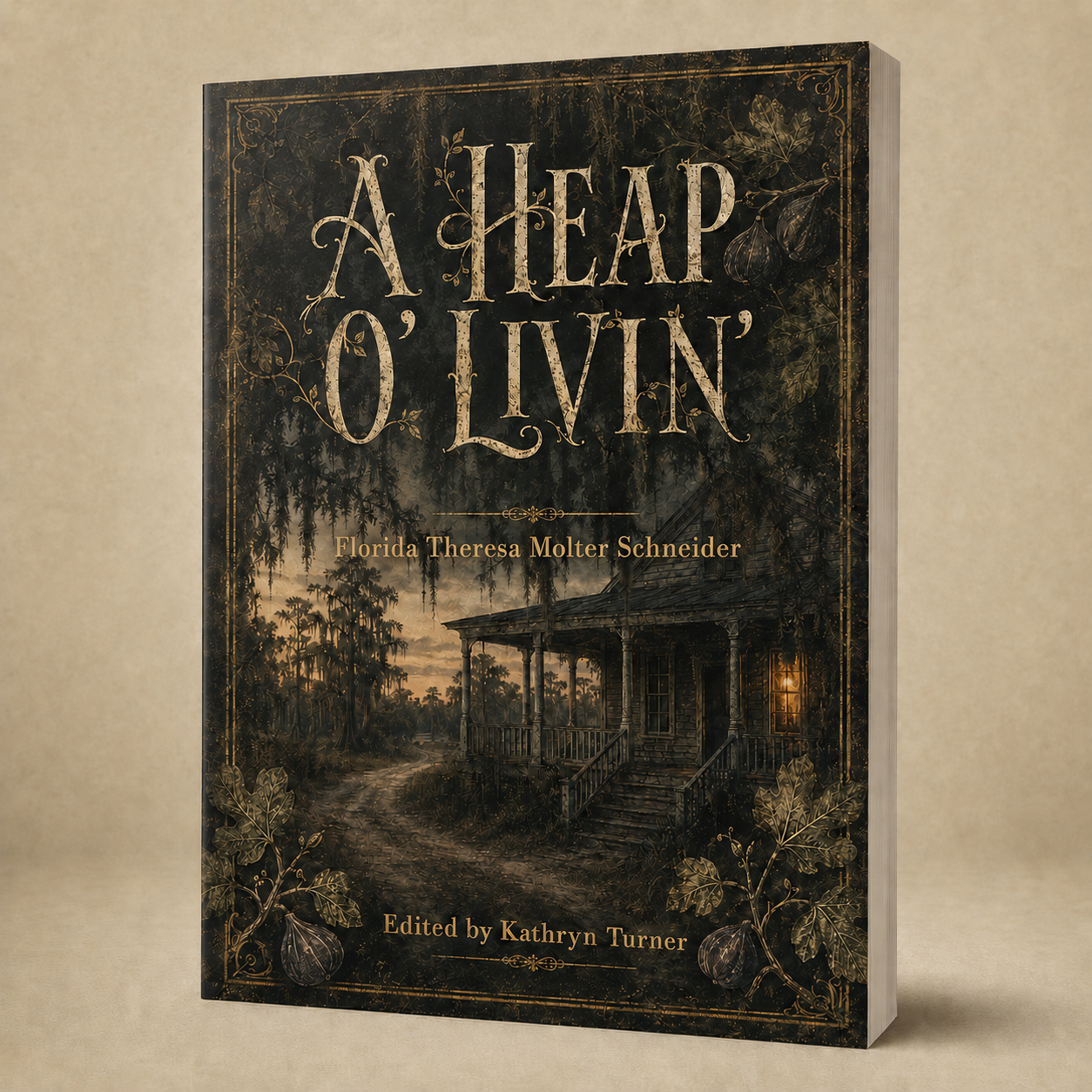
A Heap O’ Livin’ is the memoir of Florida Theresa Molter Schneider, a vivid family chronicle of childhood, hardship, humor, faith, and survival in early twentieth-century America. Written with warmth and plainspoken detail, Florida’s recollections follow the Molter family through a life of constant movement and reinvention, from the Midwest to Texas, Key West, Gainesville, Missouri, Arkansas and beyond.
At the center of the memoir are “Mama” and “Papa,” Margaret Hubertz Molter and Jacob David Molter Sr., whose large family lived through hurricanes, illness, poverty, war, work camps, farms, railroad towns, and the ordinary dramas of growing up.
Florida remembers these years through the eyes of a child and young woman: drying fruit on hot tin roofs, singing wartime songs, caring for siblings, watching brothers leave for war, surviving frightening encounters, laughing through pranks, and absorbing the lessons of a family that endured by staying useful, resourceful, and close.
This second edition, edited by Kathryn Turner, restores A Heap O’ Livin’ as both a family treasure and a historical record. Florida’s memoir captures the texture of rural and small-town life in the 1910s and 1920s, including women’s labor, sibling bonds, Catholic family life, railroad-era migration, World War I home-front anxiety, and the complicated landscapes of the American South and Midwest.
More than a genealogy, A Heap O’ Livin’ is a testament to memory itself: how ordinary lives become history when someone takes the time to remember them. Florida’s voice preserves a vanished world of crowded kitchens, muddy roads, church bells, hard work, and fierce love, offering readers an intimate portrait of one family’s search for home.
Paperback. Ships by Dec. 1, 2026.
Every purchase goes toward procuring copyright and saving Florida stories.